
KING WEST COMMERCIAL REAL ESTATE
King Street West from Spadina to Dufferin has undergone more concentrated physical and demographic change over the past two decades than any other commercial corridor in Toronto's inner city. What was a mid-century industrial and warehouse district, defined by brick and beam construction, wide floor plates, and loading doors flush with the sidewalk, has absorbed layer upon layer of repurposing: first as live-work and creative office space, then as hospitality and entertainment, and most recently as the ground floor of one of the city's densest residential accumulations. The transit priority designation introduced in 2017 accelerated that density and permanently altered the street's commercial dynamics.
The Corridor
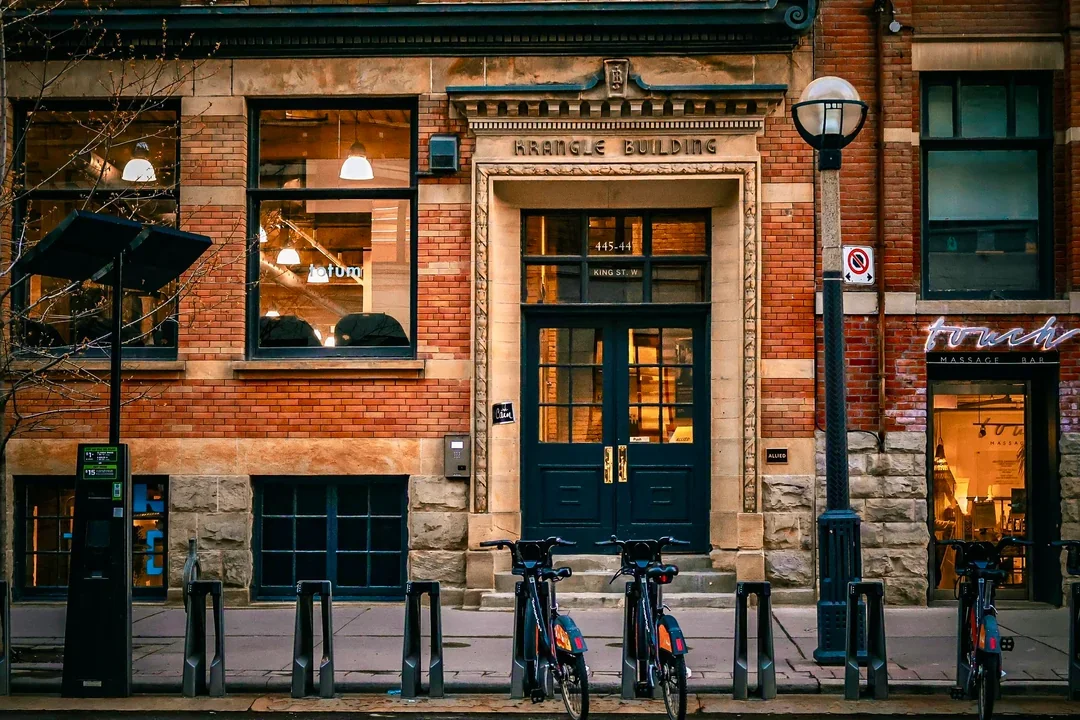
The buildings that remain from King West's industrial and warehouse era are among the most spatially compelling commercial assets on any Toronto corridor. Timber columns, concrete floors, double-height ceilings, windows scaled to industrial rather than retail purposes: the spatial characteristics that defined these buildings as production and warehousing spaces now make them distinctive venues for hospitality, gallery, showroom, and creative professional use. Several have been converted to boutique hotel or restaurant purposes; others have retained their commercial character across multiple tenancies while the residential towers accumulate around them. The gap between a well-maintained adaptive reuse building on King West and a ground-floor unit in a new mixed use condominium is spatial, material, and commercial, and it is reflected in rental rates and buyer demand.
New construction on King West has introduced a different layer of commercial inventory: ground-floor condominium units in mixed use towers, owned by individual investors or developers, sized for retail and café use, and priced at premiums that reflect the residential density above them more than the commercial income they generate. These are a different asset class from the heritage and adaptive reuse buildings that give the corridor its character, and they require a different investment analysis.
The Market
Ground-floor retail and restaurant rents on King West between Spadina and Bathurst are among the highest on any Toronto corridor, with asking rents on the most active blocks ranging from approximately $45 to $65 per square foot net, and premium corner or patio-eligible units above that range. The hospitality concentration, the residential density, and the foot traffic generated by transit have together sustained demand even as the broader retail environment has shifted.
Investment properties on King West are assessed differently depending on which layer of inventory they represent. A heritage or adaptive reuse building with a stabilized commercial tenancy and a clear income profile is valued on its income and its position as an increasingly scarce building type on a corridor that has not been kind to the preservation of that type. A commercial condominium unit in a new tower is valued as a smaller, more liquid investment with a different risk-return profile and a more volatile relationship between income and retail market conditions generally.
Shirley Yoon Kim advises on King West commercial and mixed use properties through Sotheby's International Realty Canada, with specific depth in the heritage and adaptive reuse buildings that represent the corridor's most distinctive and finite inventory. The practice covers buying and selling commercial and mixed use buildings on King West, retail and office leasing for both tenants and landlords, and the acquisition of heritage and adaptive reuse assets at every stage of their conversion trajectory. King West rewards understanding the distinction between asset types, and that distinction is where the advisory begins.
Frequently Asked Questions
-
King West commercial real estate commands higher retail rents, reflects a higher proportion of hospitality and entertainment uses, and has been more significantly reshaped by residential intensification and transit priority designation than Queen West. Queen West retains a broader tenant mix and more consistent Victorian commercial fabric. King West offers higher peak rents with more volatility; Queen West offers more stable building character at lower rents.
-
Heritage and adaptive reuse buildings on King West remain available, though supply has declined as intensification has proceeded. Brick and beam warehouse and industrial buildings remain along King West and adjacent streets, some with heritage designation and others without formal protection. When they come to market, they attract competitive interest from buyers who understand what the spatial qualities of those buildings represent and what replacement cost implies for their long-term value.
-
Commercial rents on King West's most active blocks, between Spadina and Bathurst, currently range from approximately $45 to $65 per square foot net. Premium locations, including corners and patio-eligible storefronts, ask above that range. Operating expenses and property taxes on a net lease basis add approximately $14 to $20 per square foot to total occupancy cost.
Connect with Shirley Yoon Kim to discuss a commercial property you are considering buying, selling, leasing or evaluating.